History of the Congregational Church, Kinsley, Kansas.
The present site of Kinsley was laid out by the railroad company in 1873, 332 miles west of Kansas City and one mile from the Arkansas River along the old Santa Fe Trail. The profitable trade route to the former Spanish Territorial Capitol of New Mexico was established by William Becknall of Missouri in 1822. Spain had banned trade with the United States and with France, but in 1821, Mexico gained its independence from Spain and the ban was automatically lifted.
The railroad companies of the eastern United States took advantage of these well established trade routes to the west. Santa Fe gained rail services in 1880.
Kinsley was originally named Petersburg, but this name was soon changed to Peters City to end the confusion with another Kansas town with the same name. At that time, this small outpost was considered to be about 100 miles from "civilization." Railroad officials had long recognized the stability churches provide to struggling communities on the prairie. Large bonuses were offered by the railroad companies to encourage the establishment and organization of churches in the towns laid out along the rail lines. Such was the case for "Peters City."
In 1874, a congregational church was organized by P. H. Niles and his wife and had six members. The first service was held in the roofless Kinsley Hotel, which was under construction. Mr. Niles and Mr. Edward Kinsley traveled to their native Boston to collect the money needed to build the first church building in the prairie town. $2,000.00 was collected and the building was begun. Shortly before its dedication though, a tornado tore the roof off the new church which delayed its dedication for several months until June 1887. In gratitude for his contributions in nurturing the newly established town, the town's name was changed to "Kinsley."
The small Congregational church on the outskirts of town became too small to accommodate its expanding membership. With 19 members, the Congregational church relocated to the center of town and was dedicated in the spring of 1882. Two years later, a parsonage was also completed.
By 1885, Kinsley boasted having four churches: Congregational, Presbyterian, Methodist, and Catholic. Having 55 members, the Congregationalists were the largest. Their second church building was also deemed too small and plans were made to erect an even larger edifice.
Ground was broken for the new Congregational church in April 1886. The project cost $7,000 with an additional $1,000.00 for the stained glass windows. It was dedicated on September 26, 1886. Both of the local newspapers gave detailed descriptions of the new place of worship:
The railroad companies of the eastern United States took advantage of these well established trade routes to the west. Santa Fe gained rail services in 1880.
Kinsley was originally named Petersburg, but this name was soon changed to Peters City to end the confusion with another Kansas town with the same name. At that time, this small outpost was considered to be about 100 miles from "civilization." Railroad officials had long recognized the stability churches provide to struggling communities on the prairie. Large bonuses were offered by the railroad companies to encourage the establishment and organization of churches in the towns laid out along the rail lines. Such was the case for "Peters City."
In 1874, a congregational church was organized by P. H. Niles and his wife and had six members. The first service was held in the roofless Kinsley Hotel, which was under construction. Mr. Niles and Mr. Edward Kinsley traveled to their native Boston to collect the money needed to build the first church building in the prairie town. $2,000.00 was collected and the building was begun. Shortly before its dedication though, a tornado tore the roof off the new church which delayed its dedication for several months until June 1887. In gratitude for his contributions in nurturing the newly established town, the town's name was changed to "Kinsley."
The small Congregational church on the outskirts of town became too small to accommodate its expanding membership. With 19 members, the Congregational church relocated to the center of town and was dedicated in the spring of 1882. Two years later, a parsonage was also completed.
By 1885, Kinsley boasted having four churches: Congregational, Presbyterian, Methodist, and Catholic. Having 55 members, the Congregationalists were the largest. Their second church building was also deemed too small and plans were made to erect an even larger edifice.
Ground was broken for the new Congregational church in April 1886. The project cost $7,000 with an additional $1,000.00 for the stained glass windows. It was dedicated on September 26, 1886. Both of the local newspapers gave detailed descriptions of the new place of worship:
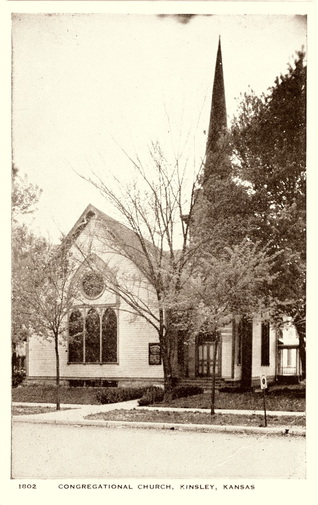
...It is heated by steam, and lit with gas,
which sparkles with beauty from twenty-
four burners upon the walls while from the
center of the ceiling, several small ones
which compose a chandelier beam as a
star of the first magnitude. On the
west wing, at the rear of the pulpit,
will be found during service hours the
choiristeer and choir. The floor
of this portion of the room being
about three feet higher than the audi-
ence room, thus giving prominence to
them and adding a cheerful appear-
ance to the surroundings. At the east
is the chapel, where prayer meetings,
Sunday School and attribute gather-
ings to the Church at large will be
held...
October 8, 1886
The Kinsley Graphic
which sparkles with beauty from twenty-
four burners upon the walls while from the
center of the ceiling, several small ones
which compose a chandelier beam as a
star of the first magnitude. On the
west wing, at the rear of the pulpit,
will be found during service hours the
choiristeer and choir. The floor
of this portion of the room being
about three feet higher than the audi-
ence room, thus giving prominence to
them and adding a cheerful appear-
ance to the surroundings. At the east
is the chapel, where prayer meetings,
Sunday School and attribute gather-
ings to the Church at large will be
held...
October 8, 1886
The Kinsley Graphic
|
...The dimensions of the auditorium are
36x45. The Sabbath school apartment is 24x34. On the rear are two rooms 10x 10, one for the pastor's study, the other for a class or music room. The enitre seating capacity of the church will be in the neighborhood of four hundred. The building is lighted by gas, furnish- ed by the Combination Gas Machine Company of Detroit, Mich. The Home Comfort Steel Frunace, made at St. Louis Mo., will be used in heating the house. A pipe organ from the factory of Henry Pilcher's Sons, of Louisville, Kentucky, has been or- dered and will be placed in position about November first... October 9, 1886 The Kinsley Mercury |
The New Organ
The new Congregational church in Kinsley gained state-wide importance with the acquisition of a pipe organ. Kinsley was the furthest city west of Emporia to have an organ. The Congregational Church in Emporia had recently installed an organ costing $2,600.00 and St. John's was the first church in Wichita to have a new organ on contract.
Professor Willis Pech accepted the post of organist of the Kinsley church early in October and immediately began the work of coordinating the dedicatory recital. 50 tickets were sold for $5.00 per couple with the remaining auditorium seats going for 75 cts and chapel seats for 50cts. All proceeds, approximately $450.00, went to pay the outstanding balance of the organ.
The organ arrived in late November and was installed under the supervision of Henry Pilcher Jr. The Kinsley Mercury gave the following description of the new organ on Dec. 11:
Professor Willis Pech accepted the post of organist of the Kinsley church early in October and immediately began the work of coordinating the dedicatory recital. 50 tickets were sold for $5.00 per couple with the remaining auditorium seats going for 75 cts and chapel seats for 50cts. All proceeds, approximately $450.00, went to pay the outstanding balance of the organ.
The organ arrived in late November and was installed under the supervision of Henry Pilcher Jr. The Kinsley Mercury gave the following description of the new organ on Dec. 11:
|
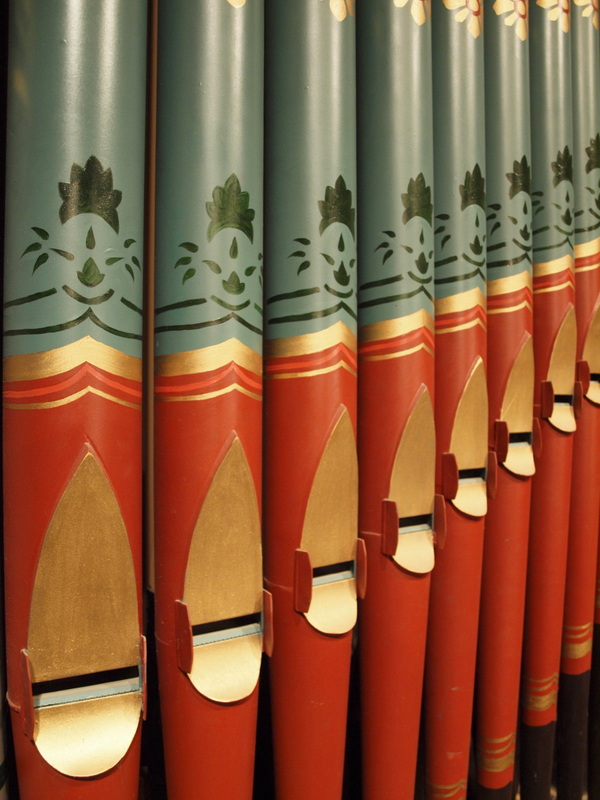
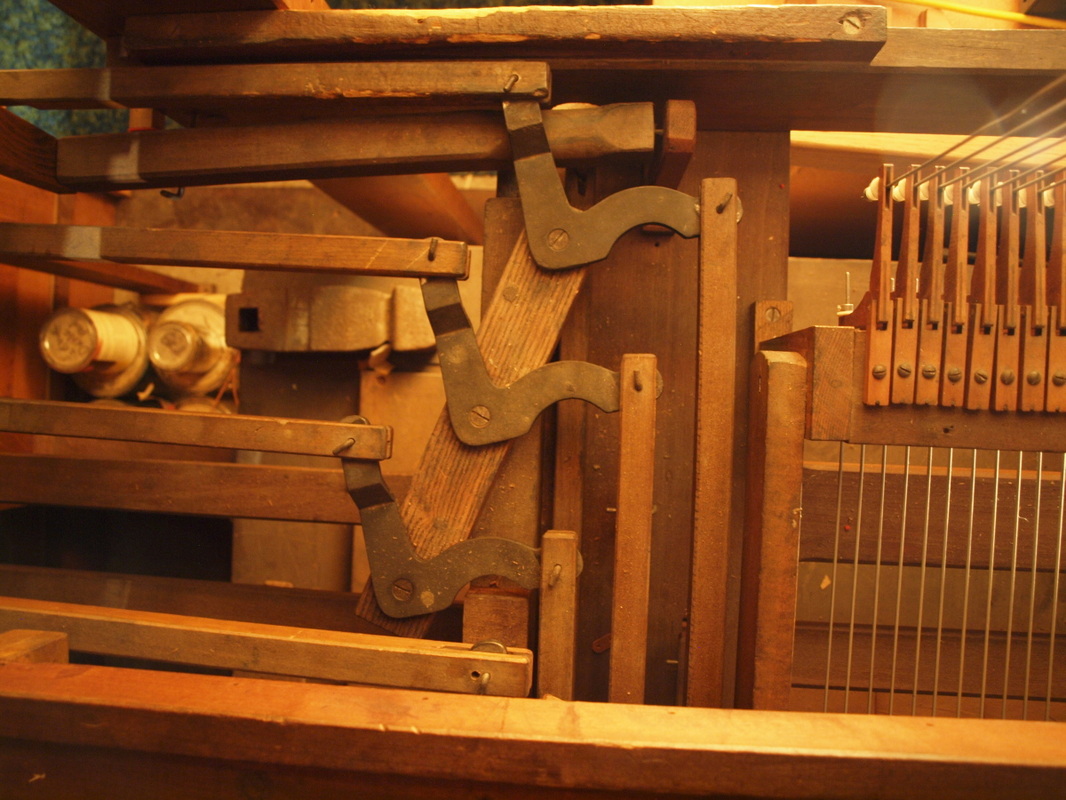
The Great Pipe Organ - The new organ which is being erected in the Congregational church occupies a space on the floor of 10 1/2 feet wide by 7 feet deep and stand nearly twenty feet high. The casework enclosing the me- chanical parts is of light wood to match the interior of the building-- the frames and moldings being of ash and the diagonal paneling of oak, all finely polished in hard oil. Surmounting the woodwork of the front are three groups of speaking pipes handsomely decorated in bright colors, relieved with gold and silver leaf; while in the rear of these is seen a group of still larger pipes, rising to a point in the center and similarly or- namented. The mechanism of the instrument is a marvel of ingenuity and somewhat difficult to describe. The wind is sup- plied by a bellows measuring seven feet long and five feet wide with doub- le feeders worked by a lever at the back. The wind is then conveyed to the four wind chests which contain the valves, of which there is one for each key and pedal. As the keys are pressed down thus opening the valves, the compressed air is admitted to as many pipes as there are stops drawn. |
There are two sets of keys and
twenty-seven pedals, besides the com- position movements for rapid changes of stops, and a balanced swell pedal, all brought under the control of one performer. Of stops or registers there are twen- ty, operated on by oblique faced knobs on either side and over the key- boards. The number of pipes is between six and seven hundred [628], varying in speak- ing length from sixteen feet to half an inch and in diameter from ten inches to the size of a goose quill. Some of the pipes are made of wood others of zinc, but the greater num- ber are of a beautiful composition called spotted metal. They also vary in shape to produce differences of tone. Nearly one half of the pipes are en- closed in a swell box, the front of which is composed of vertical shades that are opened or closed by a move- ment of the foot of the player, thus producing the crescendo and diminu- endo effects. The full power of the organ is equal to an orchestra and with as great a variety of tone; some of the stops be- ing named from and imitating orches- tral instruments. Then again the softer stops are so delicately voiced and can be so subdued at the will of the performer as scarcely to be heard. |
The dedication was held on Wednesday, December 15, 1886. The program was not limited to solo organ music, but also featured local talent in voice, piano, violin, and cornet. Several last minute changes were made in the concert program which appeared the previous Saturday in the Mercury. The following issue of the Mercury gave a detailed critique of the evening's entertainment. From this account, the following program can be reconstructed:
Part I.
Wedding March . . . . . . . . . . . . . . Mendelssohn
Quoniam Tu Solus, from the 12th Mass . . . . . .
. . . . . . . . . . . . .. . . . . . . . . . . . . . . . . . . . Mozart
Sunrise. . . . . . . . . . . . . . . . . . . . . . . . . . . . . . . .?
Caliph De Bagdad. . . . . . . . . . . . . . . . Boieldien
Bird from O'er the Sea. . . . . . . . . . . . . . . .Smart
Familiar Airs. . . . . . . . . . . . . . . . . . . .Mr. Pilcher
Dramatic Scene
Part II.
Master and Pupil. . . . . . . . . . . . . . . . . . . .Hewitt
The Deep Blue Sea. . . . . . . . . . . . . . . . . . Smart
Operatic selections and improvisations . . . . . . .
. . . . . . . . . . . . . . . . . . . . . . . . . . . . . .Mr. Pilcher
Woodnymph's Call. . . . . . . . . . . . . . . . . Williams
Arian Waltz. . . . . . . . . . . . . . . . . . . . . . . . .Vogel
The Knights Farewell . . . . . . . . . . . . . . . . . . . . ?
Home Sweet Home. . . . . . . . . . . . . . Mr. Pilcher
Remember Now Thy Creator. . . . . . . . . .Rhodes
The critic made the following observations about Mr. Pilcher's performance:
Part I.
Wedding March . . . . . . . . . . . . . . Mendelssohn
Quoniam Tu Solus, from the 12th Mass . . . . . .
. . . . . . . . . . . . .. . . . . . . . . . . . . . . . . . . . Mozart
Sunrise. . . . . . . . . . . . . . . . . . . . . . . . . . . . . . . .?
Caliph De Bagdad. . . . . . . . . . . . . . . . Boieldien
Bird from O'er the Sea. . . . . . . . . . . . . . . .Smart
Familiar Airs. . . . . . . . . . . . . . . . . . . .Mr. Pilcher
Dramatic Scene
Part II.
Master and Pupil. . . . . . . . . . . . . . . . . . . .Hewitt
The Deep Blue Sea. . . . . . . . . . . . . . . . . . Smart
Operatic selections and improvisations . . . . . . .
. . . . . . . . . . . . . . . . . . . . . . . . . . . . . .Mr. Pilcher
Woodnymph's Call. . . . . . . . . . . . . . . . . Williams
Arian Waltz. . . . . . . . . . . . . . . . . . . . . . . . .Vogel
The Knights Farewell . . . . . . . . . . . . . . . . . . . . ?
Home Sweet Home. . . . . . . . . . . . . . Mr. Pilcher
Remember Now Thy Creator. . . . . . . . . .Rhodes
The critic made the following observations about Mr. Pilcher's performance:
The “Familiar Airs,” by Mr. Henry Pilcher
on the organ, were given in an off-hand man-
ner which displayed familiarity with his instru-
ment rather than great skill in execution. The
selections however, were well chosen, some of
them being introduced by request and all
were of a character to please the popular taste.
The same critic gave the following description of the organ:
...it is from the Louisville Organ Factory,
which of itself is a guarantee of excellence,
the firm having been in existence, from
father to son, for upwards of fifty years, and
their work favorably know throughout the
country. The Scheme of the organ, submitted
by the builders and approved by the organist,
is one which within the limits could hardly be
improved. In volume it is full and rich, and in
tone has an unusual variety, from the powerful
Diapason to the delicious softness of the Dulciana.
The Melodia of the Great and Flute of the
Swell are exceptionally fine. On the Pedal
it has besides the deep Bourdon, a Violoncello
of fine quality. Mechanically too, the instru-
ment is all that could be desired. Externally
the organ presents a beautiful appearance, the
caseing being of oak and ash finely polished
and the woodwork surmounted by thirty-seven
speaking pipes in double row, handsomely
illuminated in rich coloring, relived with gold
and silver leaf. The front stands eleven feet
wide by twenty feet high. The entire cost of
the organ is about eighteen hundred dollars
which is regarded a low figure considering the
excellence of the work.
on the organ, were given in an off-hand man-
ner which displayed familiarity with his instru-
ment rather than great skill in execution. The
selections however, were well chosen, some of
them being introduced by request and all
were of a character to please the popular taste.
The same critic gave the following description of the organ:
...it is from the Louisville Organ Factory,
which of itself is a guarantee of excellence,
the firm having been in existence, from
father to son, for upwards of fifty years, and
their work favorably know throughout the
country. The Scheme of the organ, submitted
by the builders and approved by the organist,
is one which within the limits could hardly be
improved. In volume it is full and rich, and in
tone has an unusual variety, from the powerful
Diapason to the delicious softness of the Dulciana.
The Melodia of the Great and Flute of the
Swell are exceptionally fine. On the Pedal
it has besides the deep Bourdon, a Violoncello
of fine quality. Mechanically too, the instru-
ment is all that could be desired. Externally
the organ presents a beautiful appearance, the
caseing being of oak and ash finely polished
and the woodwork surmounted by thirty-seven
speaking pipes in double row, handsomely
illuminated in rich coloring, relived with gold
and silver leaf. The front stands eleven feet
wide by twenty feet high. The entire cost of
the organ is about eighteen hundred dollars
which is regarded a low figure considering the
excellence of the work.
Click on image to enlarge:
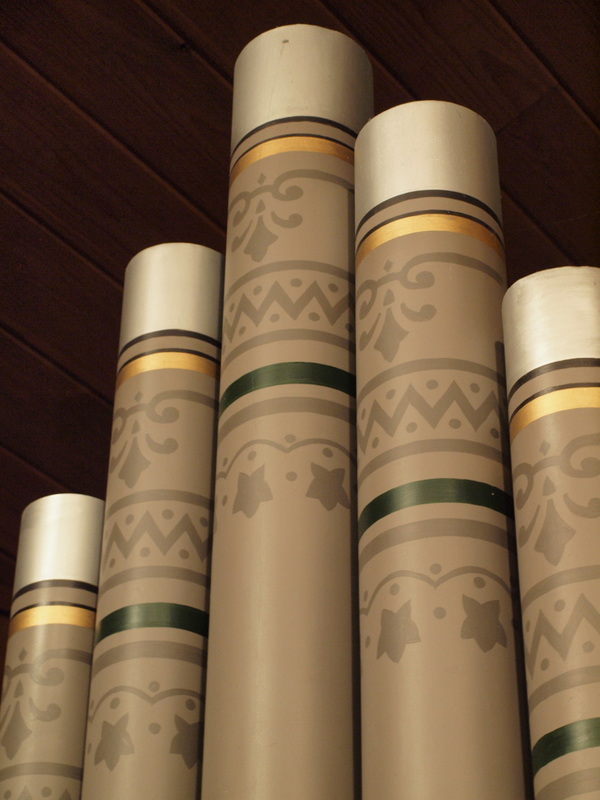
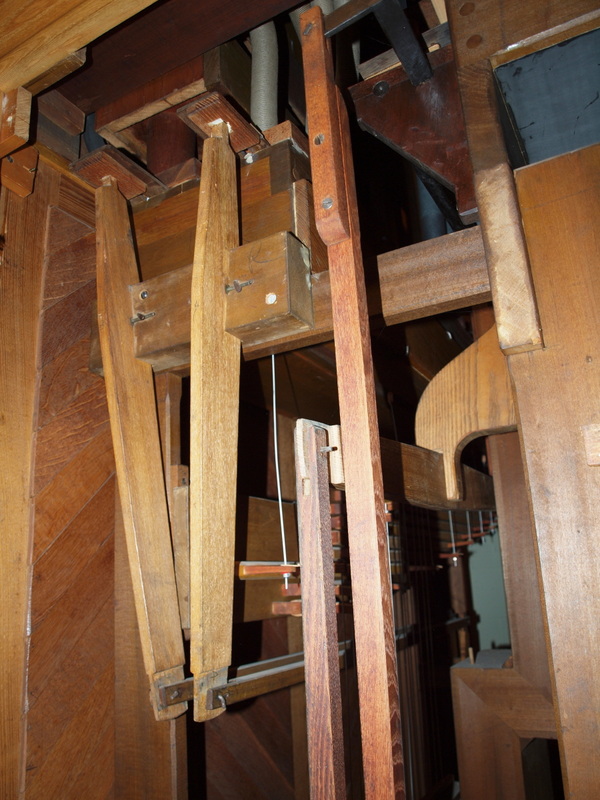
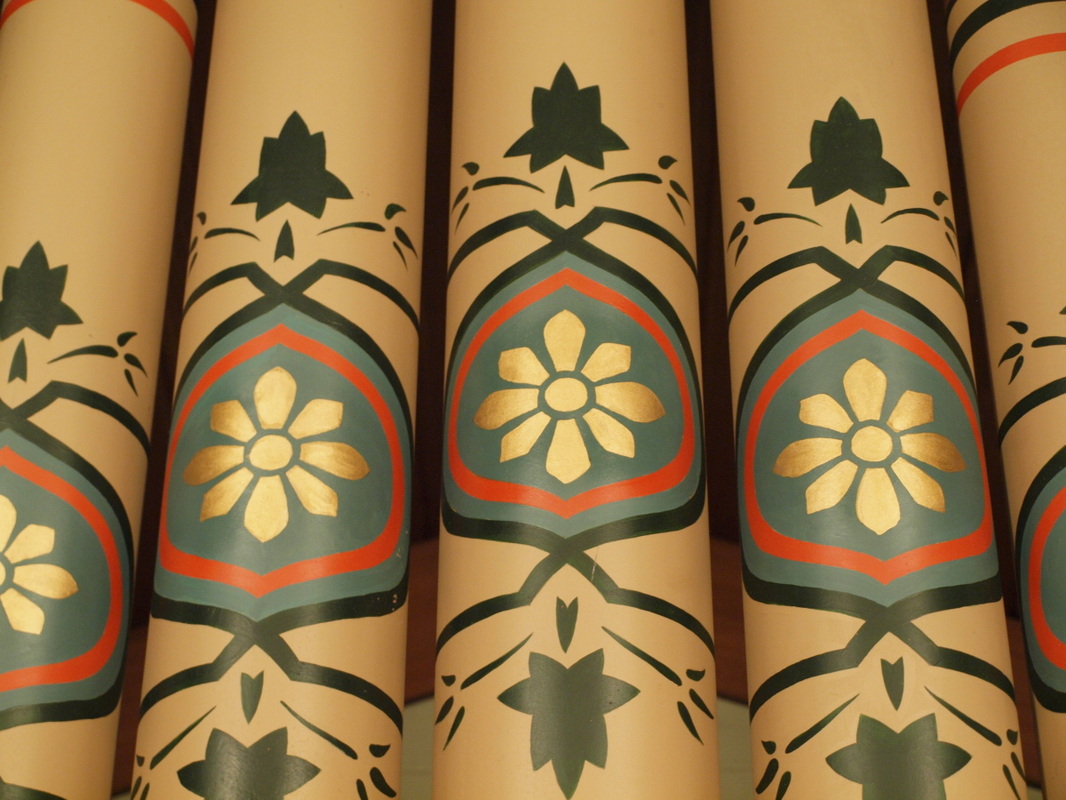
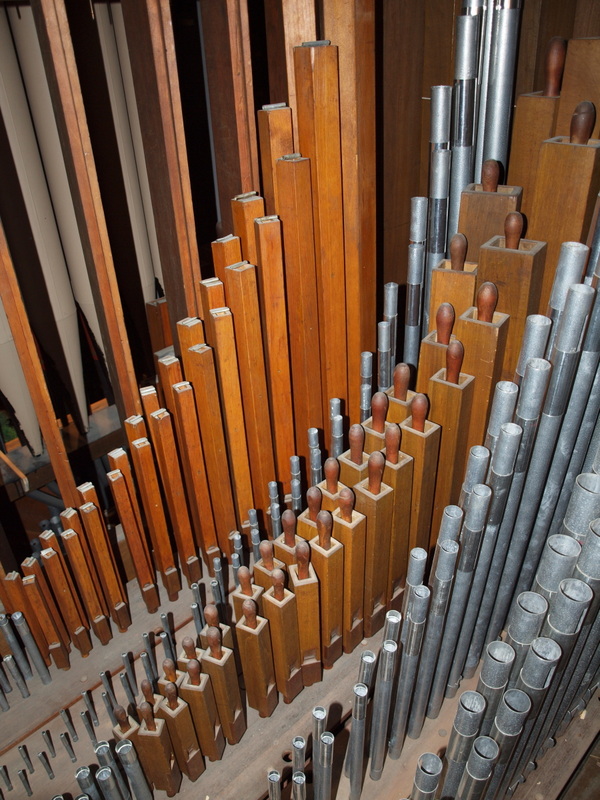
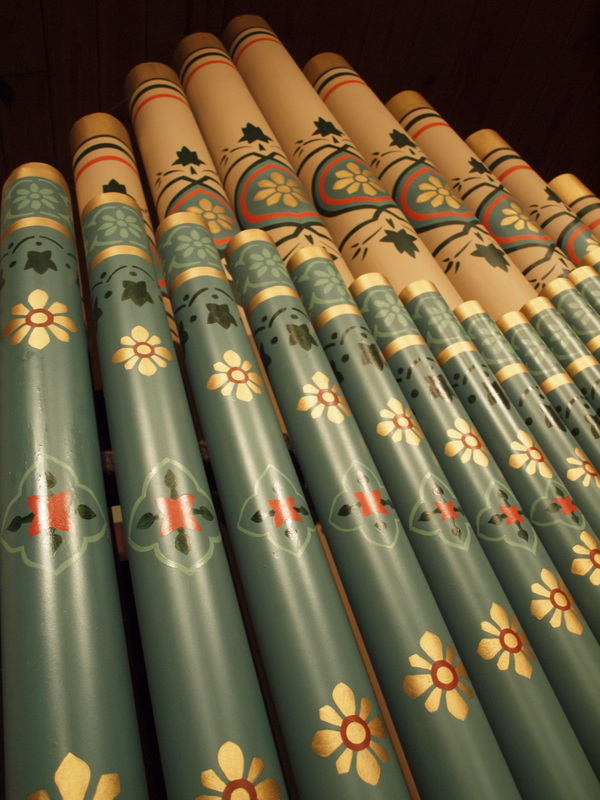
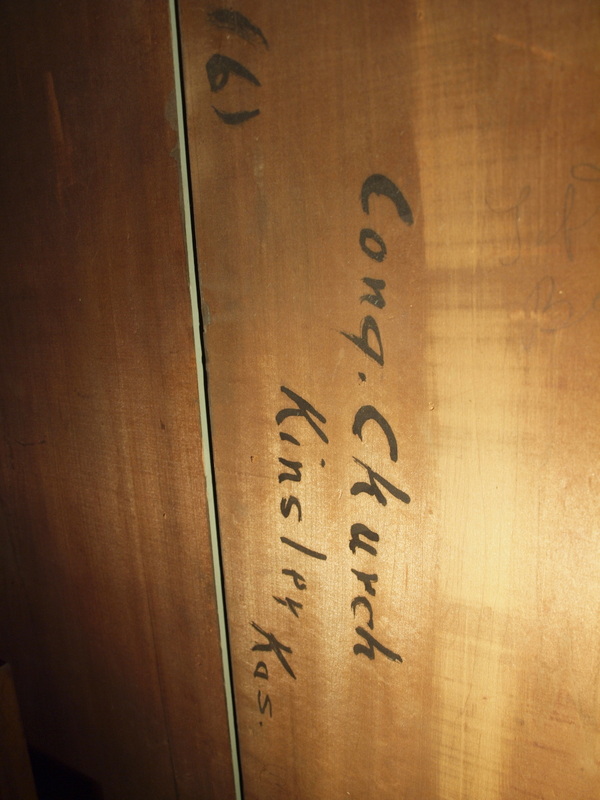
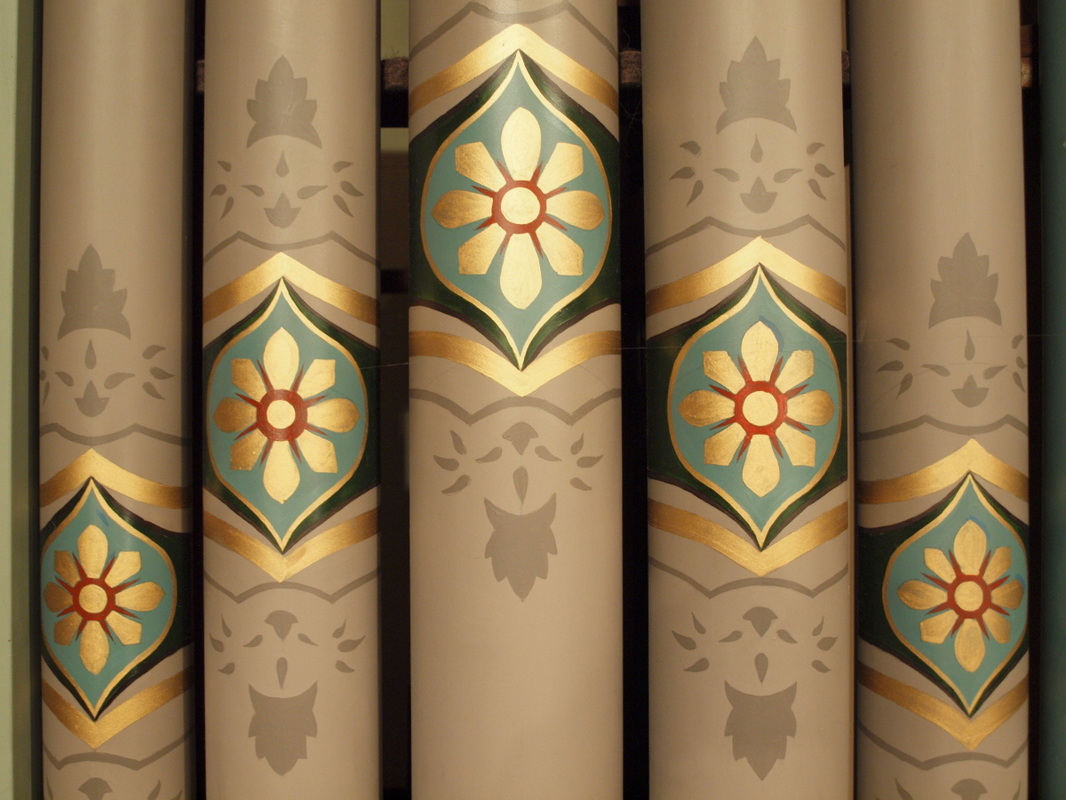
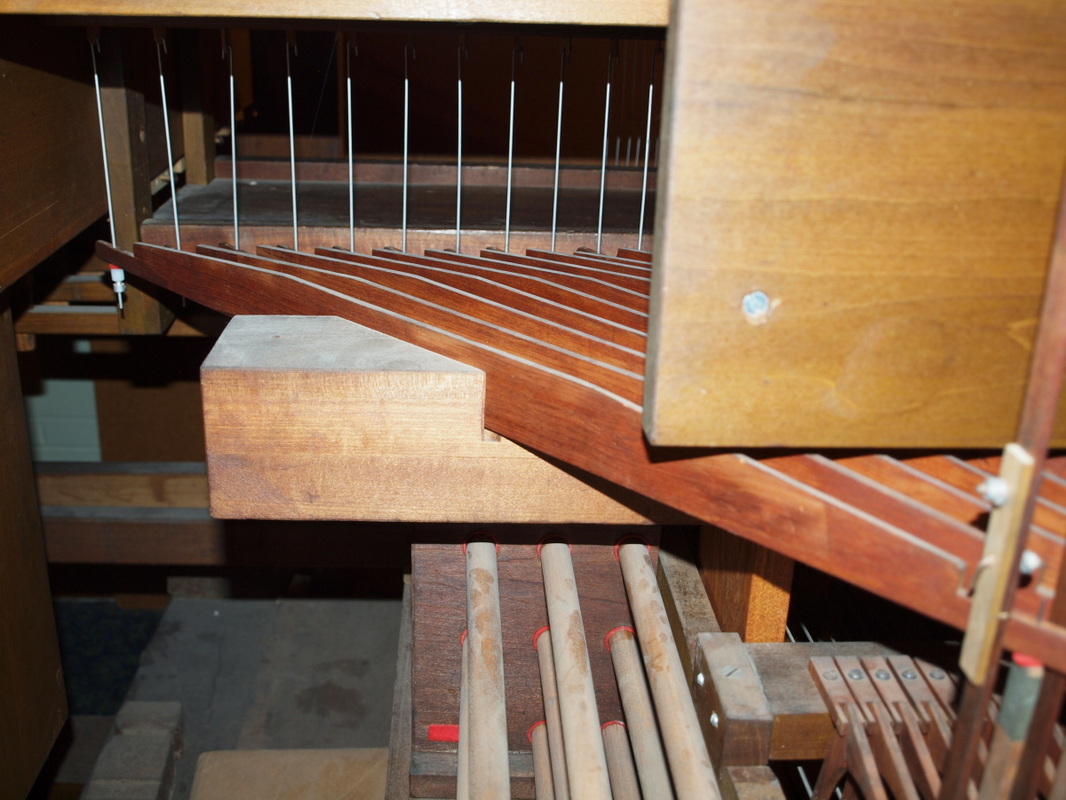
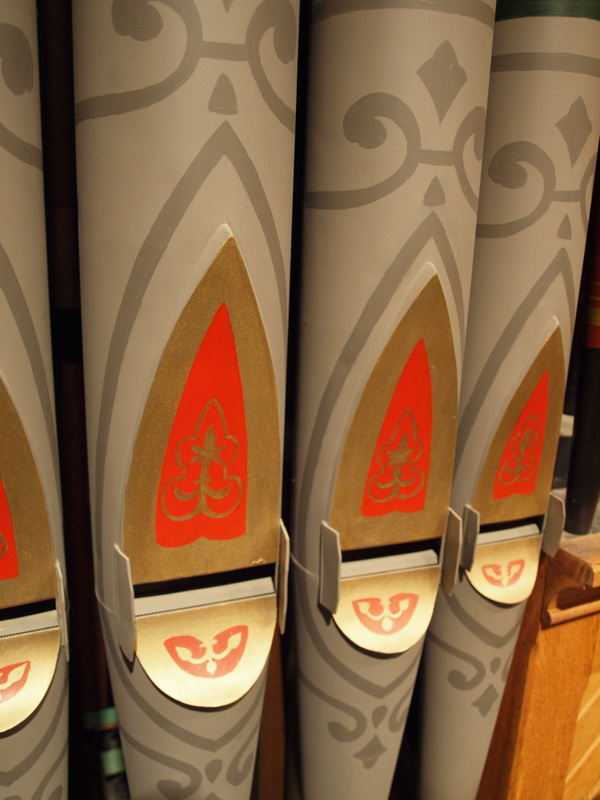
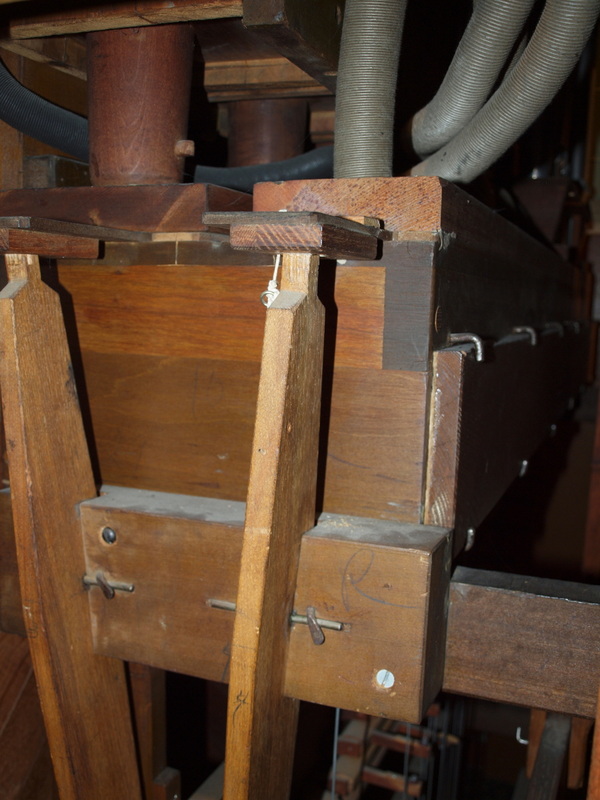
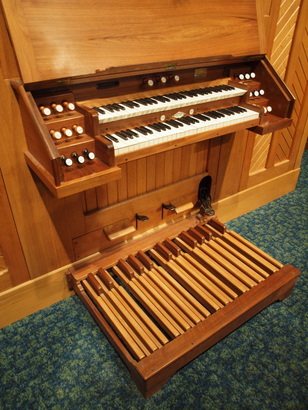
The Pilcher organ served the Kinsley congregation well until 1931 when Mr. and Mrs. W. D. West gave a substantial gift toward the purchase of a larger, more "modern" organ from the Reuter Organ Co. of Lawrence, Kansas. The gift was given in memory of the West's only son Eldred Floyd West who died at the age of 12 years. The Reuter organ had 19 stops and a 20 note set of chimes divided over two manuals and pedal with about 800 pipes in comparison to the Pilcher's 12 stops and 628 pipes.
The Reuter organ was installed in the room behind the pulpit to the left. An arched opening was cut out of the wall and filled by a screen with two flats of pipes, left and right, each with five pipe, separated by a grillwork spanned with cloth. The organ chamber had a louvered opening at the rear to allow the organ to be heard in the annex to the rear of the church. The Reuter organ was dedicated on Sunday, April 5, 1931. The old Congregational church was torn down fifty years later, in 1981, and the Retuer organ was incorporated into the plans for the new church.
The Reuter organ was installed in the room behind the pulpit to the left. An arched opening was cut out of the wall and filled by a screen with two flats of pipes, left and right, each with five pipe, separated by a grillwork spanned with cloth. The organ chamber had a louvered opening at the rear to allow the organ to be heard in the annex to the rear of the church. The Reuter organ was dedicated on Sunday, April 5, 1931. The old Congregational church was torn down fifty years later, in 1981, and the Retuer organ was incorporated into the plans for the new church.
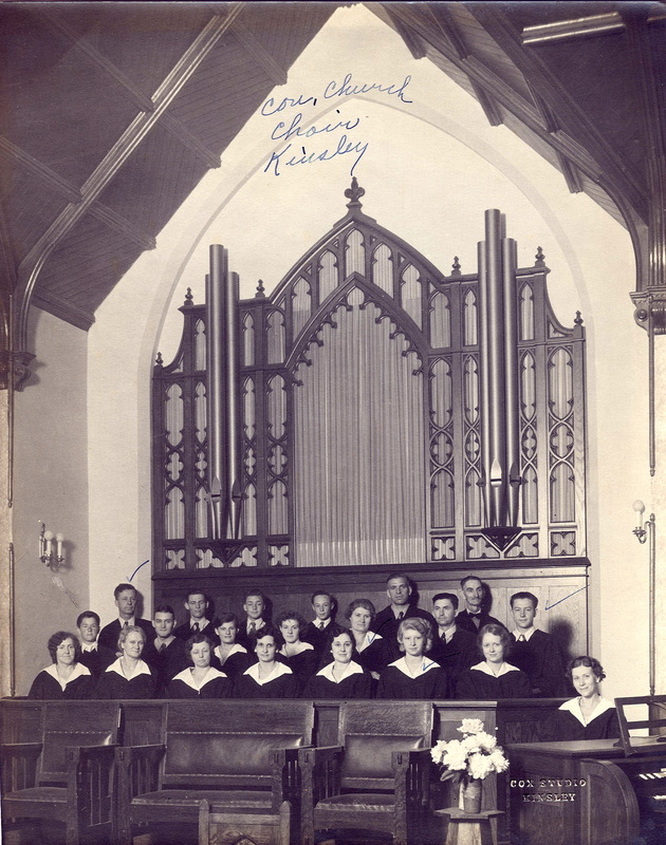
Photo above, courtesy of the Edwards County Museum, Kinsley.

Information Provided by
The Cawker City Hesperian Historical Society
All Rights Reserved
The Cawker City Hesperian Historical Society
All Rights Reserved
The C. C. H. Historical Society seeks more information about Willis J. Peck, the first organist of the Pilcher organ, and any photo showing the Pilcher organ in the Kinsley Congregational church. If you have any information, please contact us. Thanks!
